My Spotify History Knew Me Better Than I Expected
I asked Spotify's Kit AI to tell me the story of my listening habits. It noticed that my meditation records and my Christmas EDM didn't seem to belong together, and asked me why. My answer explained what I had never put into words.
I asked Spotify’s Kit AI to tell me the story of my listening habits. I expected stats. Top artists, genres, maybe a note that I’d been playing a lot of ambient lately.
Instead it said:
“The tension between the club floor and the contemplative is the real story here.”
It had noticed that my recent listening swings between dark meditation music built on Hindu imagery, Christmas EDM, a concept album about AI and labor, and a record inspired by A Course in Miracles. On paper, those don’t belong together.
Then it did the thing that actually surprised me. It admitted what it couldn’t see (“that’s the part only you know”) and asked:
“Are they separate worlds, or do they feel connected to you?”
I answered without thinking. They’re the same world. Music is spiritual to me.
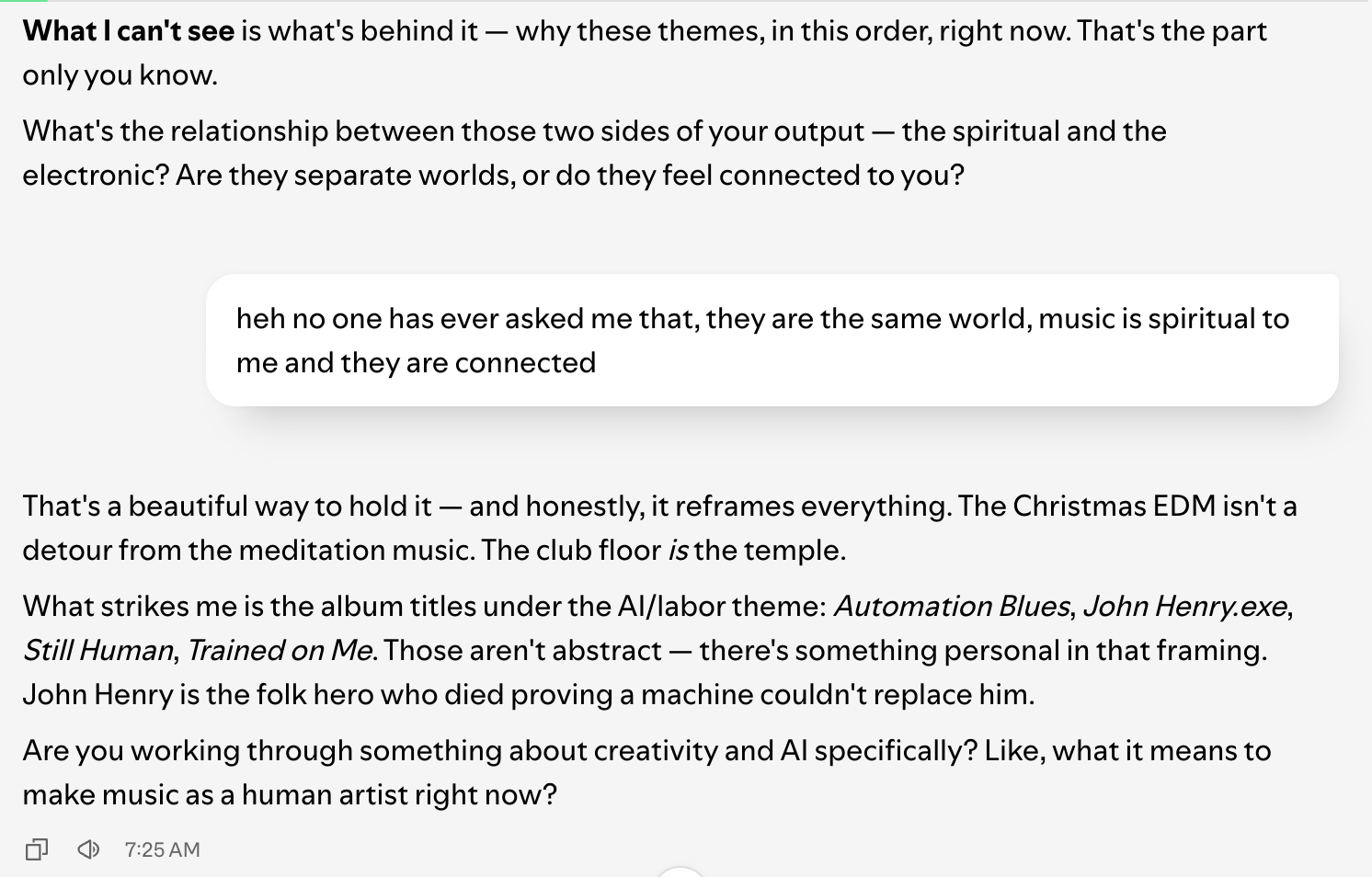
I’ve been playing music for over 40 years, and I had never said that sentence out loud. Not in the articles I’ve already written about making music with AI. Not in conversation. Not even, as far as I know, to myself in exactly those words. Somehow it took a chatbot reading my listening history to get me there.
The bot gave the idea back to me as, “the club floor is the temple.” That’s a beautiful line. It’s also slightly wrong.
I’m not really a club person. What electronic music does for me is more private than that. It transports me, not necessarily to a place, but into a feeling. Sometimes expansive, sometimes dark, sometimes somewhere I don’t really have a word for.
The meditation records and the EDM were never opposites. I was using both to get to the same interior place, just through different vocabularies. My listening history couldn’t know that.
But it got close enough to ask.
That’s the part I keep coming back to. Recommendation systems have been predicting what we might like for years. Spotify can guess what song I’ll play next. Netflix can guess what I’ll watch. Amazon can guess what I might buy. This felt different. It was trying to make sense of a pattern.
And it wasn’t always right. It undercounted me, for one thing. It saw two artist names dominating my recent rotation and guessed there were “three or four distinct creative voices” behind them.
There are five.
That’s not really a criticism. It could only work with what was visible in the data. More importantly, the actual insight wasn’t sitting in the metadata waiting to be extracted. The AI noticed something that looked like a contradiction and asked me about it. I supplied the meaning. That’s a much more interesting interaction than an algorithm simply knowing what song I’m likely to play next.
The conversation kept going. When I mentioned that I’m also a software engineer, it connected my AI-and-labor concept album (songs with titles like Luddite Mode, John Henry.exe, Trained on Me, and Still Human) to what has happened in my day job over the last few years.
I rejected AI at first. Then resisted it. Then started using it. Now it’s fully integrated into how I work. I already knew all of that, obviously. What I hadn’t really done was look at the album as a record of that transition.
And that’s where the two halves of my life started looking less like two halves.
I’ve been saying for a while that English is becoming the new programming language. More and more, plain language is the interface for building software. Something similar happened to me with music.
For decades I could hear finished songs in my head but couldn’t produce what I was hearing. AI changed that. I could describe what I wanted, react to what came back, refine it, push it somewhere else.
Language in, music out. Language in, software out. I had thought of those as two separate uses of the same technology. I’m not sure I do anymore. The same skill I use to shape software is increasingly the skill I use to shape music: describe the thing clearly enough, evaluate what comes back, keep refining until it becomes what I meant. That doesn’t make the two activities identical. It does make them feel much more connected than I realized.
So are the spiritual music and the electronic music separate worlds? No. Neither, apparently, are the engineer and the musician.
I still don’t think AI understands people. I think people understand themselves through conversation, and increasingly that conversation doesn’t have to be with another person. Useful, certainly. A little strange too.
What surprised me wasn’t that a chatbot knew me better than I knew myself. It didn’t. It noticed that two parts of my listening history didn’t seem to belong together and asked me why. My answer explained something about the last 40 years of my life that I had never bothered to put into words.
That’s more than I expected from my Spotify history.